
If you have small children, you know about developmental leaps — what English-speaking parents call wonder weeks. The kid is clingy for a few days, everything falls apart, and then suddenly they can do something they couldn't do the week before.
I think we're living through one of those leaps in AI coding right now.
The first one happened somewhere between October and December 2025. I've heard the same observation from so many colleagues by now that it's hard to dismiss: something happened there. People who had seen AI coding as an interesting demo started using it for real work. Agents stopped merely suggesting code and started finishing tasks.
The next leap is different. It isn't only that the models got better. It's that several models are now good enough to solve the same task.
When intelligence becomes interchangeable, the competition moves. From "who has the best model?" to "who can deliver the work cheapest, fastest, and with the least friction?"
That's where the price war begins.
There was no single launch in October
I went looking for the one data point that would explain the shared feeling from late 2025. It doesn't exist. What does exist is a pile-up of events that is almost more convincing.
On 29 September, Anthropic launched Claude Sonnet 4.5. They described a model that could stay on complex tasks for more than 30 hours, and shipped checkpoints, a VS Code extension, and their Agent SDK alongside it. The week after, OpenAI made Codex generally available with Slack integration, an SDK, and admin tooling. OpenAI wrote that daily Codex usage had grown more than 10x since early August, and that Codex had processed over 40 trillion tokens in three weeks.
On 20 October, Claude Code arrived on the web. On 29 October, Cursor 2.0 launched with up to eight parallel agents. On 18 November, Google shipped Gemini 3 and Antigravity as a proper agentic development platform.
It wasn't one model moment. It was the moment the entire product layer around the models fell into place: terminal, editor, browser, cloud, parallel agents, checkpoints, SDKs, and enterprise controls.
So you'd expect the public npm numbers to show the same thing. They don't, and that's worth being honest about. Claude Code fell from 22.7 to 21.6 million monthly downloads between September and December 2025 — exactly the quarter where the feeling says something changed. The growth doesn't show up until 2026.
That's not really surprising. Downloads don't measure what the feeling is about. They count installs, updates, and CI runs, not whether anyone stopped rejecting the agent's suggestions. So the curves below are a picture of how the market has moved since — not evidence of when the product layer clicked into place. The scale is logarithmic, because otherwise Claude Code would make the smaller alternatives' early movement almost invisible.
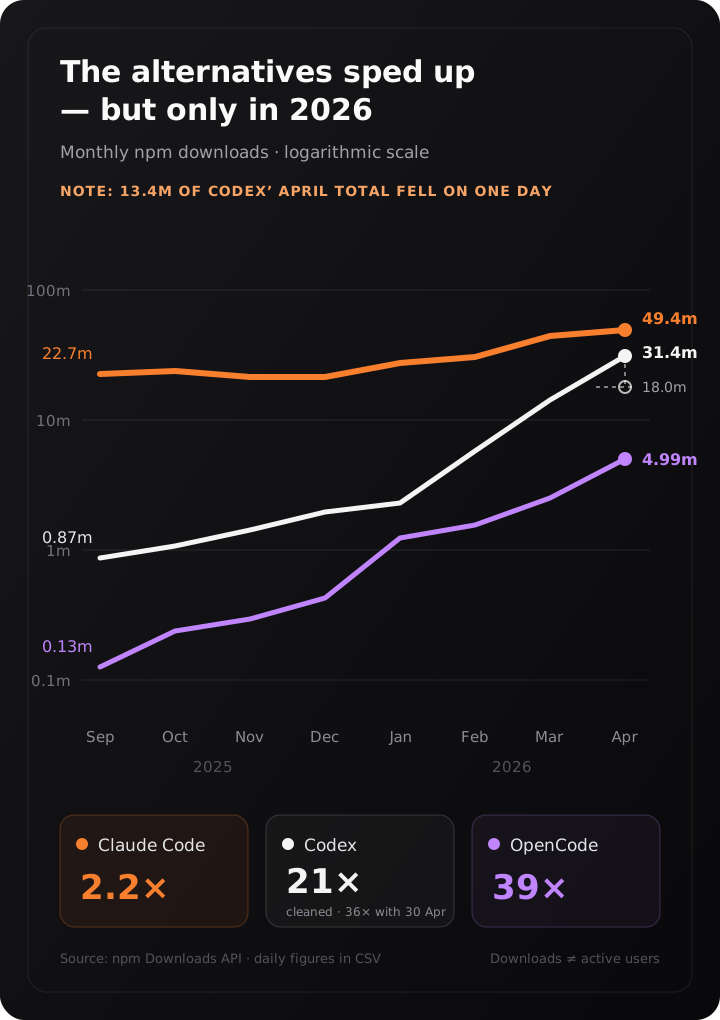
From September 2025 to April 2026, Claude Code grew from 22.7 to 49.4 million downloads a month — about 2.2x. Codex grew from 871,000 to 31.4 million. OpenCode went from 127,000 to just under five million.
But the Codex number needs cleaning up before you use it for anything. 13.4 million of Codex's 31.4 million downloads in April landed on a single day, 30 April — 43 percent of the entire month. Claude Code's biggest single day that month was under 6 percent. Subtract that one day and Codex ends up around 18 million. On top of that, OpenAI changed the package structure in February 2026, so platform-specific builds now ship inside the @openai/codex package itself, while Claude Code's equivalent platform packages sit separately and aren't counted here.
With those caveats, the movement is still large. But the right headline is that in March and in April — with the spike stripped out — Codex sat at about a third of Claude Code's downloads. Not two thirds, as the raw April number would otherwise suggest.
So maybe it wasn't the month one model won. It was the quarter the market got wider, and the alternatives started to pick up real speed.
The first leap was: agents work
Before that leap, you chose a model with the same gravity you'd bring to choosing a database. Claude or GPT? Sonnet or Opus? The wrong decision showed up in every single task.
After the leap, the question started to change. Not because the models became identical, but because more of them crossed the practical line: they could read a repository, plan, change several files, run tests, spot a failure, and try again.
That's the difference between an impressive model and a useful colleague.
I was pretty wedded to Claude myself. It wasn't a benchmark decision; it was a habit. Claude Code knew my workflow, and I knew its quirks. But today I switch to Codex on some tasks without thinking about it much. A colleague uses OpenCode. Others use Cursor, Gemini CLI, or their own combination.
What matters isn't who chose right. What matters is that we no longer feel there's only one right choice.
The monopoly isn't gone if you look at where the money goes. But it has started to disappear in our heads.
The next leap is: the model becomes a commodity
Vercel's AI Gateway offers a rare look at what actually runs in production — at least among those routing their traffic through Vercel. Their July index is built on tens of trillions of tokens a month.
One caveat needs to be kept in mind throughout: this is anonymised traffic through a single gateway. That it isn't representative of the whole AI market is my own read, not a disclaimer Vercel makes. And every time you see "spend" below, it means money spent through that gateway — not the providers' revenue.
The June 2026 numbers are striking:
- Open-weight models accounted for 29 percent of token volume, up from 11 percent in April.
- That 29 percent cost under 4 percent of total gateway spend.
- DeepSeek alone accounted for 22.6 percent of all tokens, less than two percentage points behind Google.
- Roughly one in eight enterprise customers was now running an open-weight model in production.
Two of those bullets don't count the same way, and Vercel is upfront about it. The 29 percent counts providers — only DeepSeek, MiniMax, Moonshot, and Z.ai — which Vercel itself calls a conservative definition. The one-in-eight enterprise figure counts models, and picks up Qwen, Gemma, GPT-OSS, and Kimi running on other providers' infrastructure. The direction is the same either way; the two percentages just aren't measuring the same thing.
It looks like the price war you'd expect when a capability turns into a commodity: volume seeks the cheapest acceptable supplier.
But Vercel's numbers also tell the opposite story. The four big American frontier labs still accounted for 95 percent of gateway spend. Anthropic alone took 61 percent of spend on 32 percent of tokens — and 72 percent or more of spend in the task categories where mistakes cost the most: coding agents, back-office agents, and app generation.
So traffic hasn't simply moved from proprietary to open models. The market has split in two:
Cheap volume goes to open weights. Expensive, high-risk work stays on the frontier models.
That's a more important observation than a simple story about open source winning. But pay attention to which number carries it. It's the 72 percent in the expensive categories that shows a task-dependent split. The 61-versus-32 percent split mostly shows that Anthropic costs more per token. And a gateway can see how consumption distributes — not whether individual customers are deliberately routing task by task, or whether different customers are simply building different things.
Even the premium tier has become unstable. According to the same Vercel report, Claude Fable 5 — which lists at twice the price of Opus 5 — reached 22 requests for every 100 to Opus 4.8 within four days. Three days after launch, the model was hit by a US export restriction, and Anthropic suspended access for the rest of the month. The restriction was lifted on 30 June and access resumed on 1 July — so this was a three-week interruption, not a permanent one. However you read that decision, it doesn't change the practical problem: companies can no longer build their workflow on one specific model always being available.
Kimi K3 shows both the hype and the reality
Kimi K3 is a good example of how fast the boundaries move — and of how fast you end up overstating things.
Moonshot describes a Mixture-of-Experts (MoE) model with 2.8 trillion parameters and a one-million-token context window. That number has to be read correctly: it's the total. Only 16 of 896 experts are active per token, so the part of the model that actually processes your prompt is a fraction of 2.8 trillion. Moonshot doesn't publish the active parameter count. On selected coding and GPU-kernel tasks it competes with or beats more expensive proprietary models.
That kernel result deserves an asterisk, though not the one you'd expect. Moonshot ran the evaluation itself — each model got an identical sandbox and up to 24 hours to profile, rewrite, and benchmark four kernels. What Moonshot flags is that the competitor's numbers came from somewhere else: "Claude Fable 5 was evaluated by a third party, and its results may include fallback behavior." On a separate benchmark it adds that Fable 5 hit fallbacks on 35 percent of tasks, "which may have negatively impacted its measured performance".
Read plainly, that's a vendor telling you its own comparison may flatter it. Credit where it's due for saying so — but it means the margin over Fable 5 is the softest number in this section, and it's soft in Kimi's favour, not against it.
When I checked on 24 July, the weights hadn't actually been released yet — Moonshot writes that they're coming by 27 July at the latest. At that point "open weight" was an announcement, not a download.
And the claim that Kimi K3 is generally better than Claude Fable 5 is one I can't support. Moonshot itself says K3 still trails Fable 5 and GPT-5.6 Sol overall. It's frontier-adjacent, not unambiguously frontier-best.
Then there's the price, and looking it up surprised me. Kimi charges $3 per million input tokens on a cache miss, 30 cents on a hit, and $15 for output. Moonshot reports a cache-hit rate above 90 percent on coding workloads.
Compare that with Anthropic's own price list today: Claude Sonnet 5 costs $2 and $10, with 20 cents for cache hits. Cheaper than Kimi K3 on all three numbers. It is admittedly an introductory price through 31 August, after which Sonnet 5 lands at $3 and $15 with 30 cents — exactly Kimi's prices. Claude Opus 5 sits at $5 and $25 with 50 cents for cache hits, so against that, Kimi's cache advantage is 1.67x. Not an order of magnitude.
One caveat on all of this that I only found in Anthropic's own fine print: Claude 4.7 and later use a newer tokenizer that produces roughly 30 percent more tokens for the same text. Price per million tokens is therefore not directly comparable across vendors — the same document costs more tokens on Claude than the headline number suggests. It doesn't erase Sonnet 5's advantage over Kimi, but it does narrow it, and it's the kind of thing that ought to be in every cross-vendor price table and almost never is.
It's worth holding onto, because it isn't the story the open-weights pricing debate usually tells. The open challenger hasn't undercut the frontier labs in the mid tier. It has hit exactly the same price point — and the labs have already matched it.
And Opus 5 is interesting in its own right. On Anthropic's own Opus page there's a customer quote: "On FrontierCode 1.1, Claude Opus 5 approaches Fable-level performance at half the cost." Read it precisely. The hedge is on the performance — approaches Fable-level — and it's scoped to one benchmark. The half-price claim, by contrast, is exact: Fable 5 lists at $10 and $50, precisely twice Opus 5. Those are a customer's words, not Anthropic's benchmark claim. But the fact that the lab chooses to highlight that particular comparison says something: the frontier lab has started cannibalising its own premium tier.
That's what a price war looks like before anyone officially calls it a price war.
Subscriptions hide the real price
There's still a strange gap between subscriptions and API consumption.
As an individual developer, you can buy a subscription with generous but vague limits. As a company, you're often moved onto seats, API tokens, gateways, and usage-based billing. That makes comparison nearly impossible: what does a million tokens cost on a subscription, if the vendor won't tell you how many you actually bought?
Now we have a concrete data point. In the week of 13–19 July, ccusage reported roughly $3,100 in computed token cost for our Claude usage. We pay $200 a month for Claude Max at the 20x tier.
There's a trap in that number, and I fell for it myself at first. ccusage's weekly total was $3,445, but it sums all agents on the machine. $334 of that was GPT-5.6 Sol run through Codex — consumption that was never under the Claude subscription. The $3,100 is the Claude portion alone, and that's the one the comparison needs.
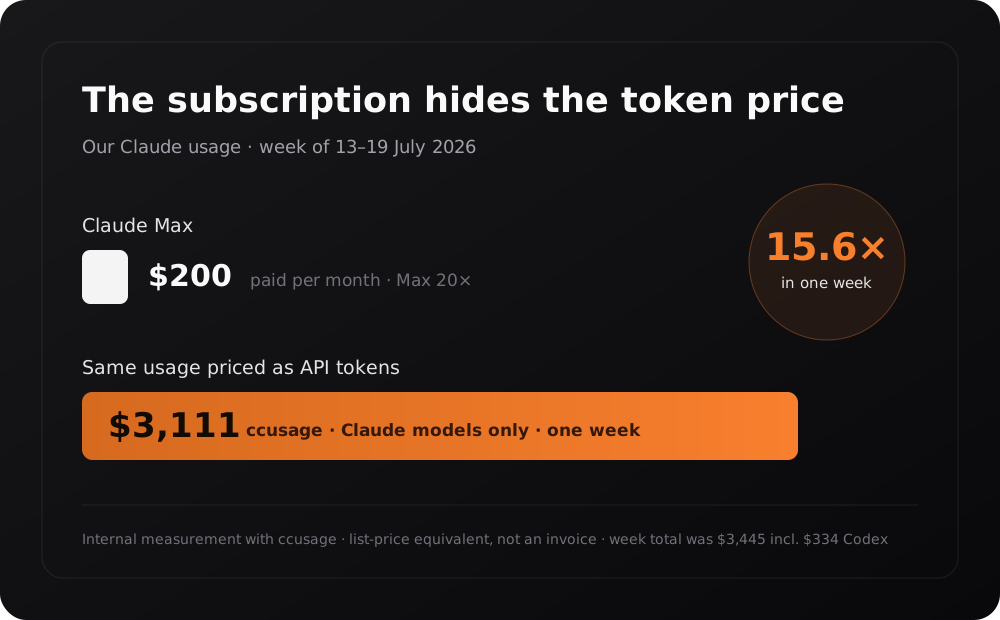
That doesn't mean Anthropic handed us $2,900, or that we'd definitely have bought exactly those tokens through the API. ccusage reads local sessions and computes a cost from the models' token prices. The figure is therefore an API list-price equivalent, not an invoice.
But as evidence of the subscription's value it's hard to ignore: in one week we recorded usage worth 15.6 times the entire monthly price. If that pace could hold for four weeks, the list-price equivalent would be around $12,400 — roughly 60 times the subscription price.
That "if" is doing a lot of work. The subscription has rate limits, and in practice you can't run a week like this one four times in a row without hitting them. The number is a ceiling on what the week was worth in list price, not a forecast. And that's exactly why companies should measure their own actual subscription-to-API ratio instead of borrowing mine.
At Firtal Web the maths ran the other way entirely. On the Danish Marketingpod podcast, Jesper Hvejsel says around 08:23 that two and a half months earlier they had moved from per-user subscriptions to API tokens. Their cost dropped 10x.
That's his figure, said on a podcast — I haven't seen the invoices, and it deserves the same scepticism I applied to my own number above. But the direction fits the shape of lightly-used seats versus metered API.
The explanation isn't that API tokens are always cheaper. As he puts it, there were people who had subscriptions but simply weren't using what was in them. He mentions an average of 120–125 prompts — and that's a combined figure, not per person. Per employee it works out to about 1.1 prompts. He had been convinced himself that the subscriptions were a good deal. After the switch he could see that one price for everyone was markedly more expensive for their particular usage pattern.
The two findings only look like a contradiction: for our intensive Claude Code week, the subscription was absurdly cheap relative to API list price. For Firtal's broader employee base, API billing was 10 times cheaper than subscriptions. Both results can be true, because a subscription doesn't have one right price. It depends on how much of the hidden token pool each user actually converts into work.
So the fight won't only be about price per token. It's going to be about holding onto tokens: subscriptions, credits, caching, rate limits, free models, bundling, and discounts that make it expensive or annoying to move your consumption elsewhere.
The valuable layer moves up
If I can switch from Claude to Codex in the middle of a working day, the model isn't the whole product any more.
What becomes valuable instead:
- the context the agent is given
- the tools and permissions it can use
- the feedback it gets from tests and evals
- the way work is split up and reviewed
- the history, memory, and integrations around it
That's the layer some people call a harness. I think of it more as the workplace around the model. When the worker is replaceable, it's the workplace, the processes, and the organisation's knowledge that make the difference.
This is also where the enterprise market gets interesting. Companies shouldn't be asking "which model do we standardise on?" They should be asking:
- Which tasks require the most expensive frontier model?
- Which can be sent to a cheaper or open-weight model?
- Can we switch models without losing context, tools, and governance?
- Are we measuring price per token, or price per accepted task?
The last one is the important one. A model at half the price is more expensive if it needs three times the review. An expensive model is cheap if it gets the task right the first time. Tokens are a commodity; finished, accepted work is the product.
The leap
The first leap made AI agents usable.
The next one makes them replaceable.
We're not all the way there. Vercel's data shows markedly more money still going to Anthropic when mistakes are expensive. Kimi itself says K3 doesn't yet match the best proprietary models overall — and on price it hasn't undercut them, it has met them. And our own workflows are full of hidden vendor lock-in.
But the direction is hard to miss. Open weights are taking volume. Frontier models are cutting the price of formerly premium capabilities. Developers hop between Claude, Codex, OpenCode, and Gemini. Gateways turn routing into a configuration rather than a strategic marriage.
For a long time the question was who would win the model race.
Maybe that's the wrong question now.
The next market will be won by whoever makes it easiest to use the model that's good enough today — and swap it out again tomorrow.
Sources and method
- Introducing Claude Sonnet 4.5, Anthropic, 29 September 2025.
- Codex is now generally available, OpenAI, October 2025.
- Claude Code on the web, Anthropic, 20 October 2025.
- Cursor 2.0: New Coding Model and Agent Interface, Cursor, 29 October 2025.
- Start building with Gemini 3, Google, 18 November 2025.
- AI Gateway Production Index — July 2026, Vercel, 13 July 2026. The figures are anonymised traffic through Vercel's own gateway. That this is not representative of the whole AI market is my own assessment, not a caveat Vercel states. All "spend" in this article is therefore consumption through that gateway, not provider revenue. Note also that Vercel's open-weight share is counted by provider (DeepSeek, MiniMax, Moonshot, Z.ai — Vercel calls the definition conservative), while the enterprise-adoption figure is counted by model and includes Qwen, Gemma, GPT-OSS, and Kimi on other providers' infrastructure.
- Open AI Gateway leaderboard data, Vercel, 14 July 2026. Published under CC BY 4.0.
- Kimi K3 Tech Blog, Moonshot AI, July 2026. Benchmark, pricing, and cache-hit claims are the vendor's own. From here: "2.8T-parameter model", "effectively activating 16 out of 896 experts", "1-million-token context window", "$3.00/MTok for cache-miss input" and "$15.00/MTok for output", "cache hit rate above 90% in coding workloads", and "The full model weights will be released by July 27, 2026" — so the weights were not released as of the check date. Moonshot ran the GPU-kernel evaluation itself — "Each model works independently in an identical sandbox, with up to 24 hours to profile, rewrite, and benchmark four tasks". The third-party and fallback caveats on that page apply to Claude Fable 5, not to Kimi K3: "Claude Fable 5 was evaluated by a third party, and its results may include fallback behavior", and separately, on SWE Marathon, "Additionally, Claude Fable 5 hit fallbacks on 35% of the tasks in our evaluation, which may have negatively impacted its measured performance."
- Claude pricing, Anthropic, checked 25 July 2026. Opus 5: $5 / $25 per million tokens, $0.50 for cache hits. Sonnet 5: $2 / $10 with $0.20 for cache hits as an introductory price through 31 August 2026, then $3 / $15 with $0.30. The same page states that Claude 4.7 and later "produces approximately 30% more tokens for the same text" due to a newer tokenizer, which is why cross-vendor price-per-token comparisons are not per-task comparisons.
- Claude Opus, Anthropic, July 2026. The quote is printed on the page as "On FrontierCode 1.1, Claude Opus 5 approaches Fable-level performance at half the cost." — Scott Wu, CEO. It is a customer quote on Anthropic's own page, not an independent evaluation. Fable 5 lists at $10 / $50 per million tokens with $1 for cache hits, exactly twice Opus 5, which is the arithmetic behind "half the cost".
- npm download data: Claude Code, Codex, and OpenCode. Downloads are only a directional indicator and include updates, CI, and repeated installs. Both the monthly aggregate and the raw daily figures ship as CSV alongside the article, so the 30 April spike can be verified directly.
- Own measurement with ccusage, week of 13–19 July 2026.
ccusage weekly --breakdownreports $3,444.73 for the week across all agents; subtracting $333.62 of GPT-5.6 Sol via Codex gives $3,111.11 for the Claude models. ccusage shows costs based on model pricing; the figure is used as an API list-price equivalent, not as an actual invoice. - Marketingpod #258 with Jesper Hvejsel, approx. 08:23–08:49. The episode is in Danish; the quotes below are my translations. Hvejsel says Firtal Web cut costs 10x by moving from per-user subscriptions to API tokens "2.5 months ago" ("2,5 måned siden"), and that there were "on average between 120 and 125 prompts, so 1.1 prompts per employee" ("i snit … mellem 120 og 125 prompts, altså et 1,1 prompt per medarbejder"). The passage is machine-transcribed and cross-checked against three overlapping audio segments; the time unit for the 120–125 prompts is not stated in the clip.
Model names, prices, and market shares were checked on 24–25 July 2026. npm downloads are aggregated from the daily API figures in the CSV files that accompany the article.